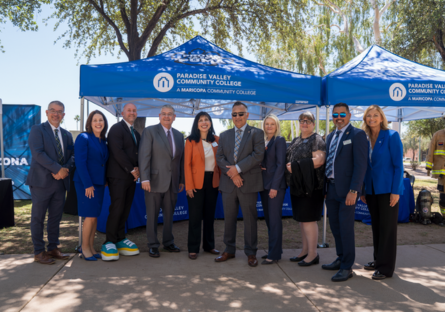
Pictured from left to right: Dr. Eric Leshinskie, Dr. Jana Schwartz, Dr. CJ Wurster, Dr. Richard C. Daniel, Dr. Veronica Hipolito, Chancellor Steven R. Gonzales, Dr. Kimberly Britt, Dr. Tiffany Hernandez, Dr. Rey Rivera, and Dr. Amy Diaz
On Wednesday, April 15, 2026, students, faculty, staff, and leaders from Maricopa Community Colleges gathered on the Capitol lawn for Maricopa Community Colleges Day at the Capitol. This year’s event coincided with Governor Hobbs’ proclaiming April as Arizona Community College Month, aligning with the national celebration, which aims to highlight why community colleges are “The Smartest First Step, The Strongest Next Step.”
“We are proud to join the Arizona Legislature in highlighting all that our system has to offer, not only for our students, but to the local community, regional workforce, and the state’s economy,” said Dr. Steven R. Gonzales, Maricopa Community Colleges Chancellor.
Picture This
Situated across the sprawling Wesley Bolin Memorial Plaza, representatives from each college showcased in-demand programs including adult education, administrative justice, healthcare and allied health, semiconductor, exercise science, construction trades, and more. Unique program offerings like Scottsdale Community College’s Equine Science—the only comprehensive degree program of its kind offered in the state, several of the system’s 11 bachelor’s programs, and Chandler-Gilbert Community College’s Unmanned Aircraft Systems (UAS) program, which prepares students to work in the UAS industry, conducting drone operations and flights, were on display for legislators and community members.
“Each year, we educate more than 140,000 learners, a vast majority of whom go on to lead and serve across the Valley,” continued Chancellor Gonzales. “The impact we have on Maricopa County is clear, which is why we are seeking a sustained investment in our system’s future, so that we can continue to do what we do best: offer the most affordable access point to high-quality, postsecondary education in Arizona.”
By the Numbers
Although Maricopa Community Colleges is the largest community college district in Arizona, it receives no operating aid from the state. Operating aid is the state’s annual, automatic funding support for community colleges, set by a formula based on annual enrollment. Since the Great Recession-era budget cuts, the 10-college system has gone without $655 million in operating aid. This year, the Maricopa Community Colleges is advocating for the restoration of systemic support in the form of operating aid over four years.
Did You Know?
Maricopa Community Colleges rely on three forms of revenue: property taxes, tuition and fees, and state-supported operating aid. Over the last 11 years, state funding has been zeroed out. According to an analysis conducted by the American Association of Community Colleges, roughly one-third of community college revenues are generated through state government sources, regardless of economic context.
Zoom In
Maricopa Community Colleges is an economic engine. According to a recent economic impact study, the system added nearly $9 billion in income to Maricopa County’s economy. The activities of the system’s 10 colleges and their students support one out of every 30 jobs across the Valley. Furthermore, the net impact of the system’s alumni currently employed in Maricopa County’s workforce amped to more than $7 billion during the 2023-24 fiscal year.
To learn more, visit maricopa.edu.